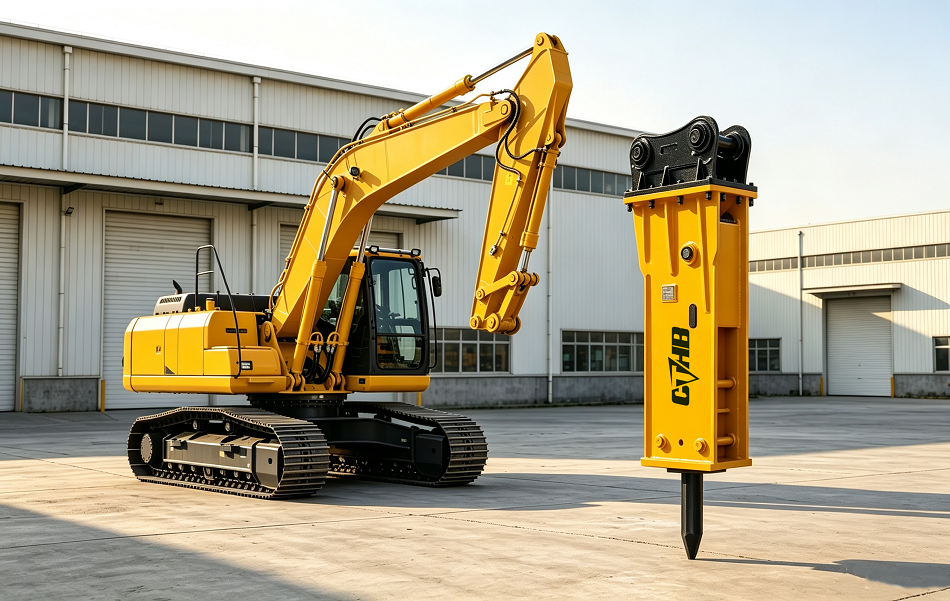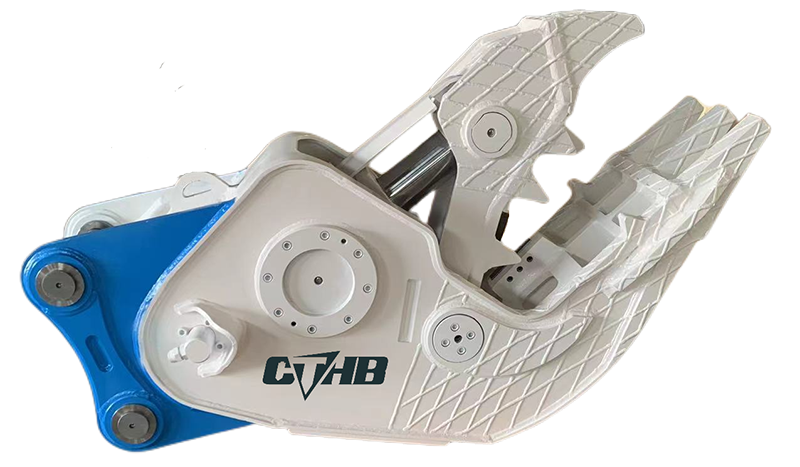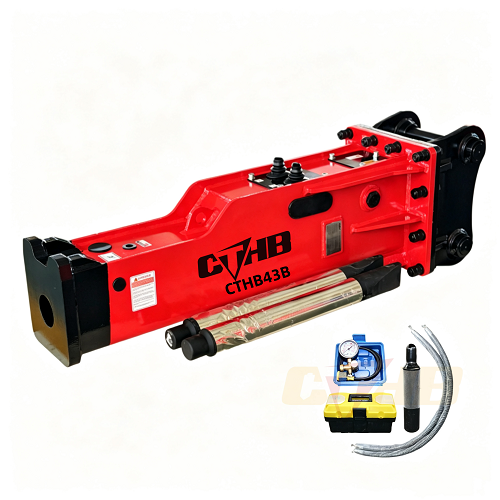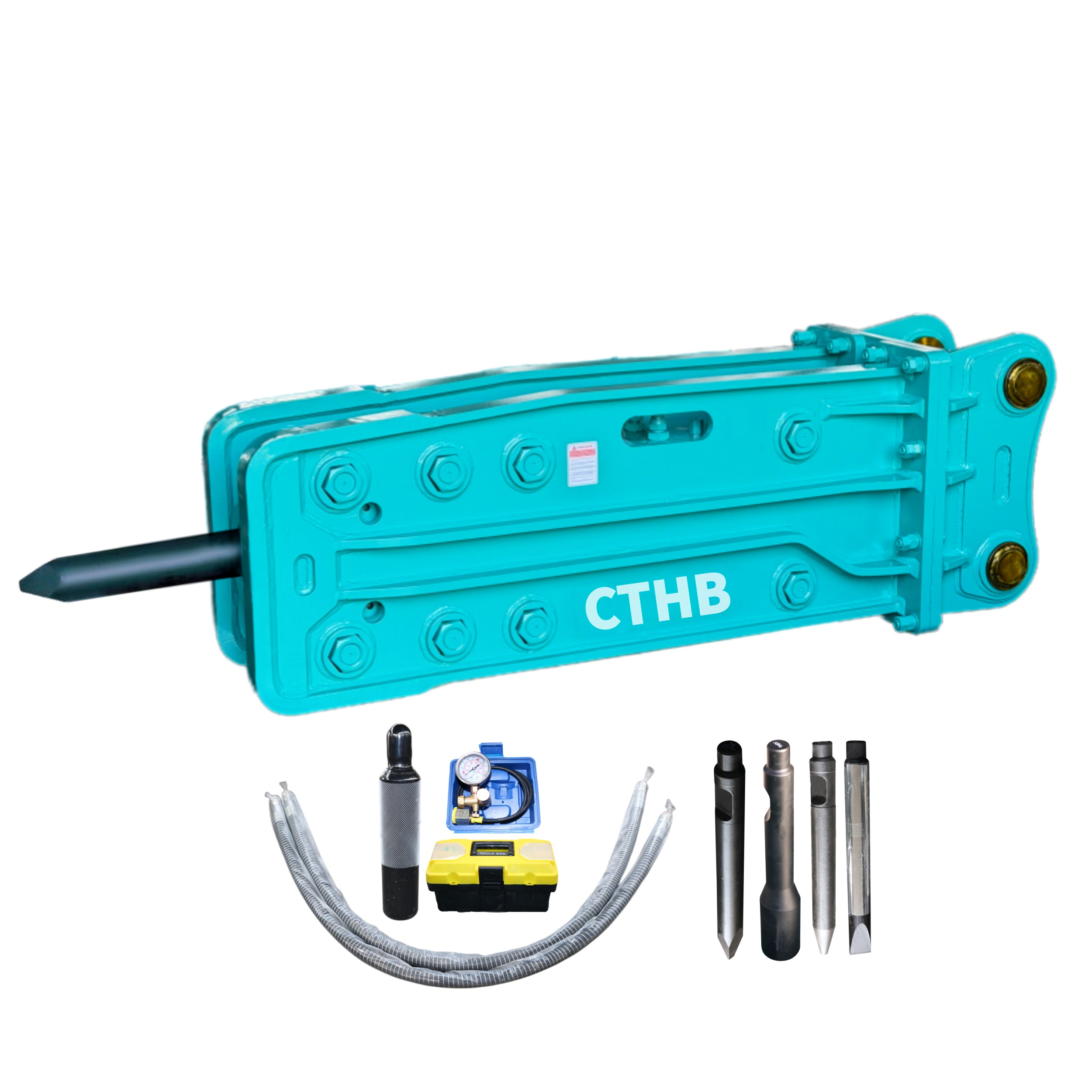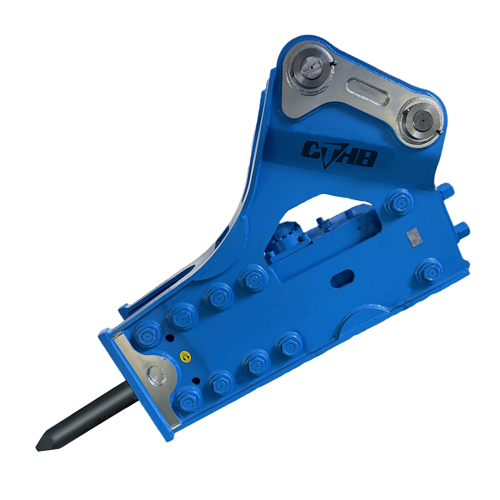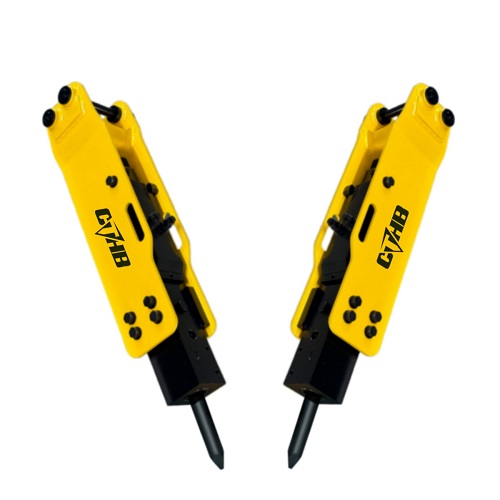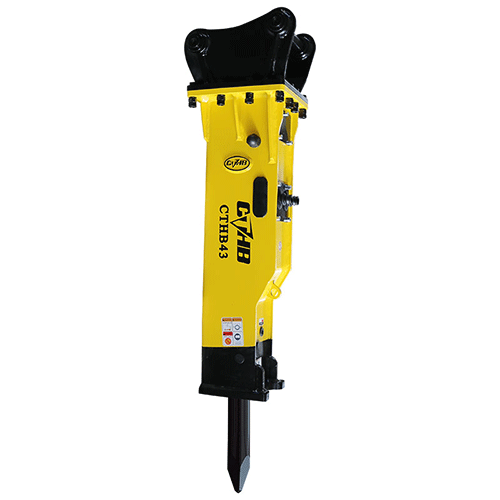
Choosing the right hydraulic breaker directly determines your construction efficiency, equipment service life and on-site safety.Also known as a hydraulic breaker, this core excavator attachment breaks rock, concrete, and hard materials through hydraulic-driven impact force.A properly matched hydraulic breaker avoids common pain points such as low breaking speed, frequent part damage, excavator hydraulic overload, and high fuel consumption.
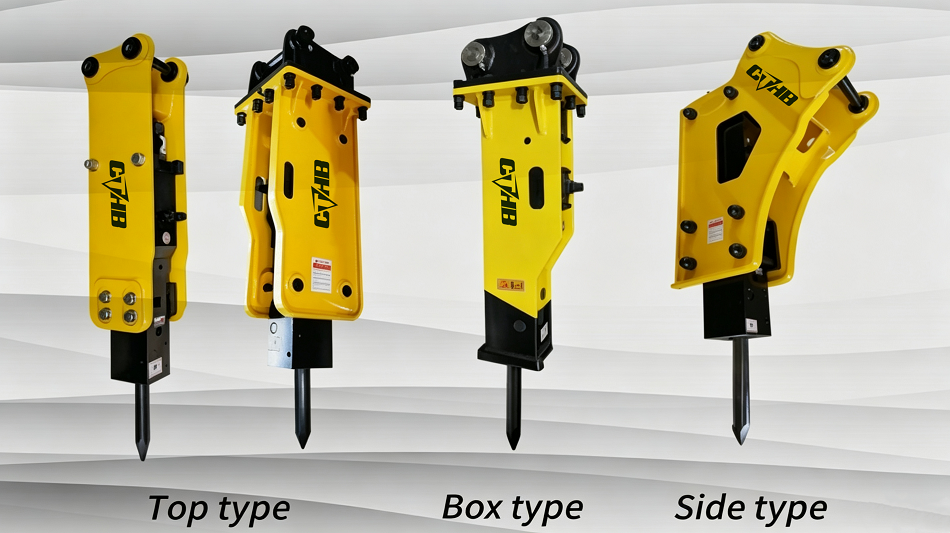
Caption: Different hydraulic breaker types for demolition, roadwork, and mining projects.
Step 1: Match CTHB Hydraulic Breaker to Your Excavator
The first and most fundamental step is ensuring your hydraulic breaker is compatible with your carrier machine—whether that’s an excavator, backhoe loader, or skid steer. This involves two critical aspects: weight and hydraulic characteristics.
Your breaker’s weight must be appropriate for your carrier.Beyond weight, you must verify that your carrier can supply the correct oil flow and pressure for the breaker. Hydraulic breakers rely entirely on the excavator’s hydraulic system for power. The breaker’s rated operating pressure (kg/cm²) and oil flow (L/min) must fully match the carrier’s output parameters, which is the key to stable working performance.
Finally, select the appropriate breaker specification and power based on the hardness of the material to be broken.
| Model | Chisel Diameter | Suitable Excavator | Hammer Weight | Operating Pressure | Operating Oil Flow | Blow Frequency | Oil Hose Diameter | Breaking Power | Auto Grease System | Back Cylinder N2 Gas Pressure | Accumulator Pressure |
| No. | mm | Ton | kg | kg/cm² | L/min | bpm | inch | kJ | ○ | bar | bar |
| CTHB05 | 35 | 0.5-1 | 117 | 90-120 | 15-25 | 800-1450 | 1/2 | 0.134 | ○ | 14-17 | / |
| CTHB10 | 40 | 0.8-2.5 | 128 | 90-120 | 15-25 | 800-1450 | 1/2 | 0.259 | ○ | 14-17 | / |
| CTHB20 | 45 | 1.2-3.0 | 146 | 90-120 | 20-30 | 700-1200 | 1/2 | 0.356 | ○ | 14-17 | / |
| CTHB30 | 53 | 2.5-4.5 | 214 | 90-120 | 25-50 | 600-1100 | 1/2 | 0.475 | ○ | 14-17 | / |
| CTHB35 | 60 | 3–5.5 | 270 | 90-120 | 25-50 | 600-1100 | 1/2 | 0.575 | ○ | 14-17 | / |
| CTHB40 | 68 | 4–7 | 324 | 110-140 | 40-70 | 500-900 | 1/2 | 0.661 | ○ | 14-17 | / |
| CTHB43 | 75 | 6–9 | 412 | 120-150 | 50-90 | 400-800 | 1/2 | 0.756 | ● | 14-17 | / |
| CTHB45 | 85 | 7–14 | 766 | 120-150 | 50-90 | 400-800 | 3/4 | 0.935 | ● | 14-17 | / |
| CTHB50 | 100 | 11–16 | 1,015 | 150-170 | 80-110 | 350-700 | 3/4 | 1.564 | ● | 14-17 | / |
| CTHB60 | 125 | 15-18 | 1,780 | 150-170 | 80-110 | 350-700 | 3/4 | 1.877 | ● | 14-17 | / |
| CTHB70 | 135 | 16-21 | 1,910 | 160-180 | 130-150 | 400-800 | 1 | 2.668 | ● | 14-17 | / |
| CTHB81 | 140 | 18-26 | 2,100 | 160-180 | 120-180 | 350-500 | 1 | 3.196 | ● | 14-17 | / |
| CTHB81A | 140 | 18-26 | 2,197 | 160-210 | 120-180 | 400-550 | 1 | 3.204 | ● | 14-17 | 55-60 |
| CTHB100 | 150 | 26-30 | 2,265 | 160-180 | 150-210 | 350-450 | 1 | 3.758 | ● | 14-17 | 55-60 |
| CTHB121 | 155 | 28-32 | 2,781 | 160-180 | 180-240 | 300-450 | 1¼ | 5.014 | ● | 17-20 | 55-60 |
| CTHB131 | 165 | 30-35 | 2,996 | 160-180 | 200-260 | 250-400 | 1¼ | 6.974 | ● | 17-20 | 55-60 |
| CTHB140 | 165 | 32-38 | 3,314 | 160-180 | 210-270 | 250-380 | 1¼ | 7.052 | ● | 17-20 | 55-60 |
| CTHB151 | 175 | 37-45 | 4,108 | 160-190 | 210-290 | 200-350 | 1¼ | 8.153 | ● | 18-22 | 55-60 |
| CTHB185 | 185 | 45-50 | 6,352 | 205-245 | 220-300 | 180-200 | 1¼ | 13.255 | ● | 22-25 | 55-60 |
| CTHB195 | 190 | 48-55 | 7,125 | 225-265 | 270-330 | 180-200 | 1¼ | 15.521 | ● | 25-28 | 55-60 |
| CTHB210 | 210 | 60-75 | 7,836 | 245-285 | 290-350 | 150-180 | 1¼ | 20.435 | ● | 25-28 | 55-60 |
*Caption: CTHB Hydraulic Breaker Parameter Table
Step 2: Select the Right Hydraulic Breaker Structure Type
CTHB Hydraulic breakers are divided into three mainstream structures, suitable for different construction environments and budget needs.
CTHB Series breaker Advantages & Applications |
||
|
Top Type Breaker |
|
|
|
Box Silenced Type Breaker |
|
|
|
Side Type Breaker |
|
|
Step 3: Match Chisel Type According to Working Needs
The chisel is the core wearing part of the hydraulic breaker. A reasonable chisel selection can double the construction efficiency and reduce wear loss.
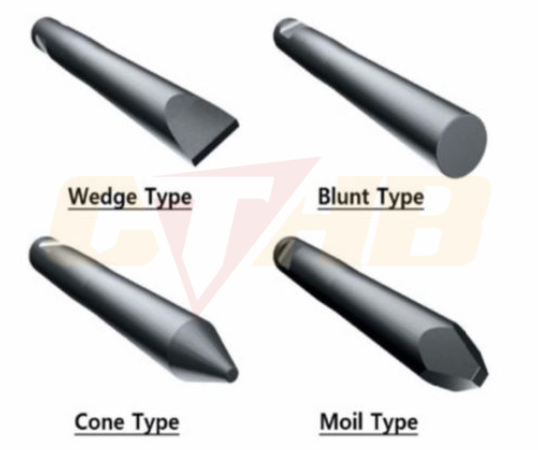
*Caption: Common chisels for different breaking tasks
– Wedge chisel: Specialized for trenching, asphalt cutting and layered rock separation.
– Blunt chisel: Universal type, suitable for concrete demolition, road peeling, and loose rock cleaning.
– Cone chisel: For breaking hard and tough rock, general demolition requiring penetrative breaking, and drilling in softer materials.
– Moil chisel: Concentrated impact force, suitable for hard rock splitting and high-hardness material breaking.
FAQs About CTHB Hydraulic Breaker Selection
Q1: What size hydraulic breaker do I need for my excavator?
Confirm the excavator’s operating weight first, comparison of CTHB hydraulic breaker specifications, then match hydraulic flow and pressure, and finally determine the type and chisel type according to materials and scenarios.
Q2: Which is better, open type or box type hydraulic breaker?
Open type is cost-effective and easy to maintain for ordinary engineering; box silent type is environmentally friendly and low-noise, suitable for urban strict environmental protection scenarios.
Q3: How to choose between high frequency and high impact breakers?
Choose high-frequency low-impact breakers for soft materials such as ordinary concrete and weathered rock; select low-frequency high-impact breakers for high-hardness materials such as granite and basalt to ensure efficient breaking effect.
Q4: Will an oversized breaker damage the excavator?
Yes. Long-term operation of an oversized breaker will cause hydraulic system overload, structural vibration fatigue, and greatly reduce the excavator’s service life.
Conclusion
To select the right hydraulic breaker, you cannot rely on experience or price alone. Standard matching must follow carrier weight, hydraulic parameters, material hardness, construction environment and maintenance conditions.An optimal matching configuration maximizes crushing efficiency, minimizes downtime caused by breakdowns, and reduces long-term operating costs, thereby generating greater economic benefits for demolition, road construction, and mining projects.